Homeowner’s Conservation Guide
How to Protect Native Desert and Regenerate Damaged Areas
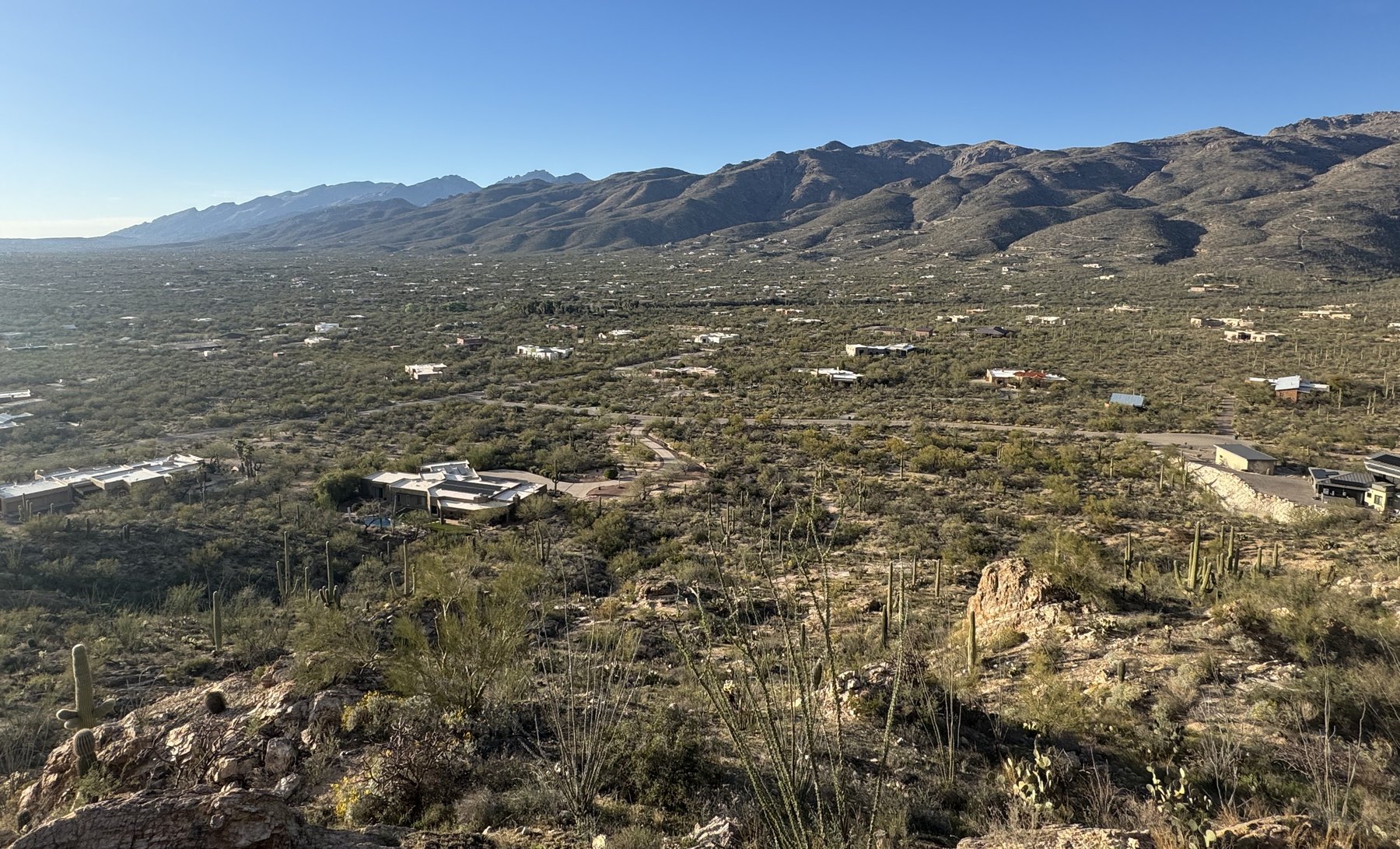
If you are fortunate enough to already have uncompromised intact desert on your property DO NOTHING except monitor for invasives. The Sonoran Desert is designed to thrive without any human intervention and receives exactly the right amount of rain water it needs from the environment. It is human intervention that has degraded it.
Steps 3-8 are applied only if your native desert vegetation has been cleared, damaged, or selectively reduced (if there has already been human impact). These steps will aid in native vegetation restoration.
Observe
‘Mother Nature’ is the best teacher. Simply observing the plants, animals and weather within your environment will teach you the most about what plants thrive where and why, the complex symbiotic relationships between different organisms, where the sun travels through the sky and where shade is cast, and how the rainwater flows through your property. Learning to observe can also bring a great sense of joy and fulfillment as we become connected to the ecosystem we live in. The Sonoran Desert is so intricate and biodiverse that even the most learned botanist can find something new to see.
Learn Your Plants!
The best way to protect, appreciate, and if necessary rehabilitate the desert is to first be able to recognize your plants and get to know what is growing on your property.
- For gardening questions of any kind, you may contact the UA Pima Extension Master Gardener through their online form. This is a great community resource and totally free of charge.
Native Plant Identification:
- Classes: Cooperative Extension Master Gardener Program. Access to experts as well as free online and in person classes, focusing on all manner of plants including natives.
- Plant Identification Apps: iNaturalist and Arizona Wildflower
- Native Plant Nurseries: Spadefoot, Desert Survivors, Rozet, Native Seeds Organization, B&B Cactus, Plants for the Southwest.
- Native Plant Index: Arizona Native Plant Society has an extensive native plant index with photos, descriptions, and planting instructions.
Books:
- Turner, Raymond M., Janice Emily Bowers, and Tony L. Burgess. Sonoran Desert plants: an ecological atlas. University of Arizona Press, 2005.
- Comus, Patricia Wentworth, Mark Alan Dimmitt, Steven John Phillips, and Linda M. Brewer, eds. A Natural History of the Sonoran Desert. Univ of California Press, 2015.
Invasive Plant Identification:
- The Southwest Vegetation Management Association (SWVMA) has an illustrated index ‘Invasive Plants Index’ that will help you learn how to recognize these species.
- The University of Arizona has a Homeowner’s Guide to Identifying and Managing Invasive Plants, including a glossary and an Invasive Plant Index.
- The Arizona Native Plant Society has an invasive plant index with photos, descriptions, and removal instructions.
- Arizona Department of Agriculture has a published Noxious Weed List.
- The Sonoran Desert Cooperative Weed Management Area (SD-CWMA) has plant profiles for several of the top priority plants in the Tucson area.
Becoming familiar with native plant species will allow you to distinguish native from invasive plants, enabling you to encourage the plants you want to grow. If you are not sure, it’s best to leave the plant alone until you can identify it.
Managing Invasive Plants: Discriminate, Selectively Pull, and Avoid Scraping, Burning, Spraying
- Use the resources above to identify invasives and learn how to pull them.
- Join a pull event in your area for an in the field experience that will equip you with the knowledge of managing your own invasives.
- Avoid spraying, burning and scraping. These practices often kill all plants indiscriminately, including your newly germinated native seedlings that you can’t see or haven’t recognized.
- If you are able to recognize native seedlings, you won’t accidentally pull them or tread on them.
- The most ideal time to do invasive weed control is to hand pull during a rainy season and before the plants go to seed. If they have not gone to seed you can use the dead plants as mulch and do not need to dispose of them.
- If you pull invasive weeds for two subsequent years, your weeds will be significantly more under control. Ground cover by mulching is your best way to deter weed regrowth and promote natives, as weedy species prefer exposed soils.
- Before using herbicide, other likely treatment options and combinations of treatments should be investigated and determined unlikely to succeed. If herbicide is deemed necessary, use the least amount of the least toxic chemical mixture necessary to achieve objectives. The amount of herbicide used can often be reduced by strategically applying another treatment method in combination. Remember to wear PPE and carefully read the label. The label is the law.
- Pima County Invasive Species Program | UA Cooperative Extension has many resources, including photos, indexes, and how-to pull guides for invasive species. Contact Ben Tully | UA Cooperative Extension Pima County’s invasive species outreach coordinator.
Harvest Your Rainwater
The biodiversity of the Sonoran Desert owes itself greatly to the phenomenon of two rainy seasons, winter and late-summer monsoons, which allows a greater variety of plants to thrive. Enabling the natural rainfall to help your plants is the best way to promote native vegetation. Passive rainwater harvesting depends on three primary principles:
- Slow the water (dissuade rapid flowing water from leaving your property and eroding soils).
- Spread the Water (send that water to plants that need it).
- Sink the Water (create areas through swales, basins, and mulching that give the water time to penetrate deep into the soil).
There are many different ways to apply these principles to your property. Once you achieve them on a practical level you essentially shorten the dry season and lengthen the rainy season by allowing water to be available to plants for longer.
*When doing anything to landscape your property be mindful that disturbing the ground can damage soil crusts and roots. Rainharvesting falls under permaculture, which should only be done if the ground is already bare and damaged. It might be safer to add soil to create basins and swales instead of digging down and disturbing roots and soil crusts.
Building basins can also allow you to bury unwanted branches underground thus nurturing the soil biology. Re-introducing organic material is a great way to restore damaged soils back to health.
Here are several local resources with rain harvesting support and guidance:
- BYOB ‘Build Your Own Basin’ Pamphlet offered by Watershed Management Group, a short pamphlet on how to construct a basin to allow rainwater to penetrate the ground
- Rainwater Harvesting Rebate City of Tucson Rainwater Harvesting and Greywater Harvesting Classes offered for free through Watershed Management Group and be eligible for up to $2,000 in grant subsidies for harvesting on your property.
- Explore the Watershed Management Group for other programs designed to encourage sustainable water use in Tucson watershedmg.org
- Follow the activities of rainharvesting and permaculture expert Brad Lancaster, who has transformed Tucson’s ‘Dunbar Spring Neighborhood’ into a thriving urban food-forest by harvesting rain runoff from paved areas.
- ‘Rainwater Harvesting for Drylands and Beyond’, indepth book on rainwater harvesting techniques.
- Follow Brad on Instagram @drylandwaterharvester for up to date rainharvesting inspiration, including workshops, and events.
- Explore rainharvesting techniques accomplished by the Dunbar Spring Neighborhood Foresters
- Lancaster’s theories have revolutionized the City of Tucson’s landscaping practices, which now mandate that all commercial landscapes must incorporate rainwater harvesting since 2005.
- Water Harvesting Guidance Manual offered by City of Tucson
‘Plant Like Nature’
- Choose plants that naturally grow in your bioregion. They have evolved over thousands of years to survive in this area. They are pollinators for native insects and integral food sources for all the wildlife that evolved alongside them.
- Lower the temperature of your property and soils by planting canopy trees like mesquites and palo verdes.
- Seed and promote pioneer plants–Brittlebush, native Prickly Pear, Creosote and Bursage are your friends! These species are among the few plants that can survive in a cleared area and will later act as companion plants to all other species. Pioneer plants will naturally regenerate but you can expedite this by promoting (watering, mulching, etc) existing plants to become ‘self-seeders’ that naturally seed the surrounding area.
- Why choose native? You can include non-native species and incorporate these into the Sonoran Desert vegetation as long as they are not invasive. Be aware that non-natives have not adapted to the animal and insect predators of this region and are often more heavily targeted by javelinas, packrats, pocket gophers, rabbits and other wildlife. It is often best to put non-natives inside your fenced areas for this reason.
- With time, your property will naturally regenerate without your help if you simply allow it. Millions of seeds lay dormant in your soils. Once harmful human interference (landscapers, spraying, etc) is stopped, the desert ecology will slowly return on its own.
- You don’t have to pick one or the other! Natives and non-natives can thrive together. Incorporate non-natives within the native desert plants, as they will act as companion plants to non-natives and help them survive this climate.
- The Arizona Native Plant Society provides a list of landscapers and nurseries in Pima County that sell native vegetation.
Irrigation
- If you have Subsurface Drip Irrigation (SDI) capabilities, your best use of water is allowing your canopy layer nurse plants to grow quickly. If you harvest rainwater and occasionally hand water you do not need to use SDI; however, SDI irrigation is a beneficial way to fast-track canopy nurse plants so that nature can do the rest of the work.
- Irrigate newly planted canopy trees regularly at first and then irregularly as they become established, encouraging deeper and more diversified root growth. Desert plants will grow very quickly when irrigated and you will have substantially more shade in 5 years and canopy within 10 years. You will not have to irrigate once these become larger trees unless they have been planted in highly exposed areas where they would not have naturally survived (ie. Velvet Mesquites grow in valley bottoms and low points that get surrounding runoff, not on hilltops).
- Irrigate pioneer plants so they can mature quickly and self-seed the rest of your property, creating an understory desertbrush canopy that sets up all other native plants to germinate and thrive.
Mulch
- Organic (woodchips) and inorganic (aggregate) mulching allows the ground to absorb more water when it rains and keeps soils and roots cooler.
- Woodchips in shady areas (around the base of canopy trees) essentially imitates a forest floor. The organic material gives microbes and mycelium sustenance, which creates an underground network of resource sharing among plants, including water. Woodchips inhibit weeds but applied too thickly they will also inhibit native seed germination until they have decomposed, so use accordingly. You can get your woodchips from a local arborist which often contains ground up leaves as well as bark, improving compostability. Purchased woodchips do not have the ability to bond with soil microbes in the same way and can float during heavy rainfall.
- Use rocks as mulch in sunny areas, allowing naturally deposited native seeds to find a cool protected spot to germinate. Rocks also deter rapid growth weeds that prefer bare ground. A mixed size of rocks will give you an advantage; evenly sized gravels thickly applied are not ideal and will act as a deterrent to all plants.
- Contact your closest arborist for woodchips. They will often dump it for free. Ensure they do not have invasive plant seeds in the loads.
Who to Hire? Landscapes versus Smartscapers
- Professional landscapers tend not to discriminate when conducting weed control. They often kill all your native seedlings and your succession plants before they can be recognized. They also remove dormant species when they appear as dead sticks.
- If you hire landscapers, ask that they become SmartScape trained. Smartscape is a free course offered in both English and Spanish that equips landscapers with all of the steps necessary to maintain and regenerate native desert on your property.